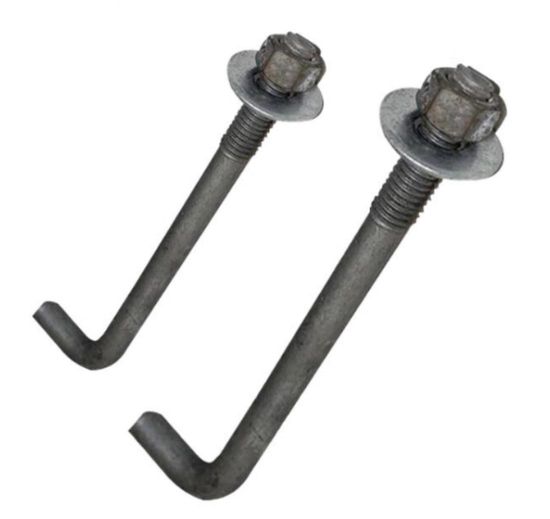
Anchor Bolts & Foundation Bolts Manufacturer: J-Bolts, L-Bolts, U-Bolts and Cast-in Anchors to Drawing
An anchor bolt is the piece of steel that disappears into concrete. Once the foundation pour is done, the bolt in the slab is not coming out to be reworked. If the bend radius is wrong, the embedment is short, the threads are the wrong length, or the coating fails in wet concrete, the structural steel erector discovers it on the day the column goes down — and the correction involves drilling out the concrete, grouting a repair, or redesigning the baseplate on site.
On a drawing, an anchor bolt is a simple line: a rod, a bend at the bottom, a thread at the top, two nuts and a plate. In practice, the bend geometry, the embedment depth, the thread length above the concrete, the nut and washer stack, and the coating for buried service are all specified by the structural engineer, and they are the dimensions the RFQ has to carry correctly the first time.
Yuanpai manufactures anchor bolts, foundation bolts, J-bolts, L-bolts, U-bolts and cast-in anchor assemblies for EPC contractors, structural steel fabricators and equipment OEMs worldwide, working to ISO and EN standards as primary, with ASTM materials supplied wherever the customer's drawing calls them up. This guide covers the anchor bolt types buyers actually specify, the bend and embedment logic, the coating choices for buried service, and the dimensions an RFQ should carry to come back complete.
For the broader custom fastener range, start at the custom fastener manufacturer center.
Yuanpai Anchor Bolt Quick Reference
- Products: J-bolts, L-bolts, U-bolts, double-ended anchor rods, straight holding-down bolts, anchor cage assemblies
- Primary standards: ISO 898-1 (property classes), EN 10204 (certification), EN 1992-4 (concrete fastenings, where referenced)
- Customer-specified: ASTM F1554 grades 36 / 55 / 105, ASTM A307 Grade A, where the drawing calls them up
- Diameters: M12 to M64 (1/2" to 2-1/2"); larger custom anchors to drawing
- Embedment: per structural drawing; design-dependent per ACI 318 / EN 1992-4 (not a default)
- Threads: rolled on precision anchors; cut on light-duty straight anchors
- Finishes: black / plain, hot-dip galvanized ISO 10684, epoxy coated, zinc flake
- Assemblies: anchor + 2 nuts + flat washer + square plate washer where specified
- Documentation: EN 10204 3.1 per heat; mill cert traceability
1. Anchor Bolt, Foundation Bolt, J-Bolt, L-Bolt, U-Bolt: What They Are
The terms are used loosely on a BOM. The five products are distinct:
- Straight anchor bolt (holding-down bolt) — a straight threaded rod with a nut and washer at the top, embedded in concrete. Used where the embedment depth and a bearing plate at the base provide the anchorage, or where the bolt is epoxy-grouted into a drilled hole.
- J-bolt — a rod bent into a J shape at the embedded end. The hook provides mechanical anchorage in the concrete. Common on light-to-medium structural columns, machinery bases and equipment foundations.
- L-bolt — a rod bent at 90 degrees at the embedded end. Similar anchorage logic to the J-bolt, with a straighter bend. Common on column bases and pole foundations.
- U-bolt — a rod bent into a U, threaded at both ends. Used primarily to clamp pipe, conduit or cylindrical members to a structure, and as an anchor where both ends protrude. It is not a deep-embedment foundation anchor in the structural sense.
- Double-ended anchor rod — a precision threaded rod with threads at both ends, one end embedded (often with a nut and bearing plate at the base) and one end protruding for the equipment. Used on heavy machinery bases, pump skids and steel structure column bases where the embedment depth is large.
The distinction matters because the bend radius, the embedment depth and the inspection expectations differ. A J-bolt for a light machinery base is not manufactured to the same tolerance as a double-ended anchor rod for a structural column. When an RFQ says "anchor bolts, 400 pcs," we confirm which form the project needs, because the bend geometry, the thread length and the assembly components all change.
2. Where Anchor Bolts Actually Go
Anchor bolts appear on almost every concrete-supported structure. The common positions:
| Position | Typical product | Typical grade | Notes |
|---|---|---|---|
| Structural steel column bases | J / L bolt or double-ended anchor | 4.6 / 5.8, HDG | Embedment per structural drawing |
| Heavy machinery / pump skid bases | Double-ended anchor rod | 8.8, HDG or epoxy | Grouted baseplate, two nuts |
| Pole and light-tower foundations | J-bolt, anchor cage | 4.6 / 5.8, HDG | Ring pattern on foundation |
| Pipe and conduit clamps | U-bolt | 4.6 / A2 stainless | Clamp load, not embedment |
| Equipment baseplates (vessels, tanks) | Anchor rod + plate washer | 8.8 / customer grade | Shear and uplift check |
| Precast concrete connections | Bent anchor, loop | Per drawing | Welded or cast into element |
The single most common anchor bolt order on our book is the structural column base: a ring of J or L bolts at each column, sized and embedded per the foundation drawing, supplied hot-dip galvanized, with two nuts and a flat washer per bolt. The second is the machinery baseplate anchor set: double-ended 8.8 rods, HDG or epoxy-coated, with a heavy square plate washer under the baseplate and two nuts above.
3. Materials and Property Classes
As a custom fastener manufacturer, Yuanpai works to ISO and EN systems as primary, with ASTM grades supplied wherever the customer's drawing calls them up:
| Class / grade | Standard | Typical use |
|---|---|---|
| 4.6 | ISO 898-1 | Light structural anchors, pole foundations, general holding down |
| 5.8 | ISO 898-1 | General structural anchor bolts |
| 8.8 | ISO 898-1 | Heavy machinery baseplates, pump skids, uplift anchors |
| A2-70 / A4-70 | ISO 3506 | Coastal or corrosive-environment anchors, stainless U-bolts |
| ASTM F1554 Grade 36 | ASTM F1554 (customer-specified) | Low-carbon cast-in anchors, equivalent to mild steel |
| ASTM F1554 Grade 55 / 105 | ASTM F1554 (customer-specified) | Higher-strength anchors, when the drawing calls them up |
| ASTM A307 Grade A | ASTM A307 (customer-specified) | General carbon-steel anchor bolts where specified |
The procurement rule: state the property class on the RFQ. "Anchor bolt, M24, 500 pcs" without a class could be 4.6 or 8.8, and the allowable load changes by a factor of two. On an uplift-loaded column base, that difference is the difference between a safe connection and an overload failure.
A note on ASTM scope: ASTM F1554 is the anchor bolt product specification — it primarily governs the grades (36 / 55 / 105), their mechanical properties, product marking, certification and dimensional requirements for the finished anchor. It does not by itself dictate the bend geometry, embedment depth or fabrication details for every anchor type; those depend on the anchor form (J, L, U, straight, double-ended) and are set by the project structural drawing, in combination with ACI 318 and AISC 360 design provisions. Where the drawing calls up F1554, the PO should specify the finished anchor to the correct grade (36 / 55 / 105), not merely "mild steel anchor." We map each line on a mixed ISO / ASTM BOM to the correct standard at quotation.
4. The Hook, Bend and Embedment Question
The embedded end of a J, L or straight anchor is what transfers load into the concrete. Three dimensions are fixed by the structural engineer and must be on the drawing:
- Embedment depth — the length of bolt buried in concrete, measured from the top of the slab to the bend or the base of the straight rod. Too-short embedment pulls out under uplift. Embedment is set by the structural engineer per ACI 318 (US) or EN 1992-4 (Europe) based on factored load, concrete strength, edge distance and anchor type; as a rough reference it often falls in the range of 15–30 bolt diameters, but this is not a default and must be taken from the drawing.
- Bend radius — the bend on a J or L bolt has to be large enough that the bar does not crack on the inside of the bend, and small enough that it fits the foundation rebar cage. Cold-bending large-diameter bar to a tight radius work-hardens and weakens it; the bend radius per drawing is not a free parameter.
- Bearing plate / nut at the embedded end — on double-ended anchors, a nut and bearing plate at the embedded end provide the mechanical anchorage; on straight cast-in anchors, a welded plate or a forged foot may be specified.
The threaded end above the concrete is equally specified:
- Thread length above the slab — long enough for two nuts (one for leveling, one for locking) plus the baseplate thickness plus a small protrusion, and not so long that the bolt protrudes above the finished column.
- Nut and washer stack — usually two hex nuts and a flat (or square) washer per anchor. The leveling nut sits under the baseplate; the locking nut sits above.
When we quote a J or L bolt, we confirm the overall length, the embedment depth, the bend radius and the thread length above the slab on the drawing before production. These are the dimensions the foundation contractor checks against the rebar cage, and they are the most common omission on a first RFQ.
For US structural engineers, the anchorage design behind these dimensions is governed by ACI 318 (Building Code Requirements for Structural Concrete, Chapter 17 on anchoring to concrete) for the concrete-side pullout, pryout and splitting checks, and by AISC 360 (Specification for Structural Steel Buildings) for the baseplate and anchor connection design on the steel side. On European projects, the equivalent is EN 1992-4 (design of fastenings for use in concrete). The bend radius, embedment and edge distances on the drawing are the output of these design provisions; the manufacturer builds to the drawing, not to a default.
5. Welding, Base Plates and Nuts
Anchor bolts are delivered as part of an assembly, not as loose rods:
- Nuts — matched to the bolt property class. On 4.6 / 5.8 anchors, a standard hex nut to ISO 4032 or the customer equivalent; on 8.8 anchors, a property-class-matched nut. Two nuts per anchor (leveling + locking) on structural bases.
- Washers — a flat or square washer under the locking nut, sized to spread the load on the baseplate. On light anchors a standard flat washer; on heavy machinery bases a square plate washer that straddles the baseplate edge. We cover the washer range in our custom washers manufacturing guide.
- Welded plates — where a bearing plate or a shear lug is welded to the embedded end, the weld procedure and the plate geometry are per drawing. Welding on a high-strength 8.8 anchor introduces a heat-affected zone and is controlled by the project specification.
Anchor bolts are also commonly shipped alongside the matching threaded rods and studs for bracing and equipment ties on the same structure, so the structural steel erector receives one lot-controlled package rather than sourcing anchors and rods separately.
RCSC note for steel erection packages. Where anchor bolts are supplied as part of a structural steel erection package to US standards, the high-strength bolts used in the steel-to-steel connections — beam splices, bracing, column splices and baseplate leveling — are commonly specified to the RCSC Specification for Structural Joints Using High-Strength Bolts. We can supply the anchor bolts alongside those RCSC-compliant structural bolts on the same lot-controlled package so the erector receives one delivery rather than sourcing anchors and erection bolts separately.
6. Coatings for Buried and Outdoor Service
An anchor bolt buried in concrete is in a damp, alkaline environment, and the portion above the slab is exposed to the atmosphere. The coating is chosen for both:
| Finish | Standard | Typical use | Notes |
|---|---|---|---|
| Black / plain oil | — | Indoor, dry, or where embedded and not exposed | Standard thread fit |
| Hot-dip galvanized | ISO 10684 | External structural anchors, buried foundations | Default for outdoor anchor bolts; threads over-tapped |
| Epoxy coated | Per project spec | Aggressive buried environment, coastal foundations | Thin film; thread fit close to standard |
| Zinc flake | ISO 10683 | 8.8 high-strength anchors, low hydrogen risk | Thin film; controlled friction |
| Stainless A4-70 | ISO 3506 | Coastal, salt, chemical plant foundations | No coating needed |
The practical rules: hot-dip galvanizing is the default for external structural anchor bolts because the buried length sees damp concrete and the above-slab length sees the atmosphere. On HDG anchors, the nuts are over-tapped to run freely on the coated thread. On 8.8 and higher-strength anchors, zinc flake or mechanical galvanizing is preferred over HDG where hydrogen embrittlement is a concern, and the coating decision is confirmed with the structural engineer.
For coastal or splash-zone foundations, the material itself may move to A4-70 stainless rather than a coated carbon steel — that is a design decision made at the drawing stage, not a field substitution.
7. Manufacturing Route at Yuanpai
An anchor bolt follows a controlled production sequence:
- Bar control — hot-rolled or peeled bar from certified mills, with EN 10204 mill certificates verified on receipt. Chemistry checked by spectrometer; heat number recorded.
- Cutting and facing — rod cut to overall length, ends faced.
- Bending — J, L or U bends formed on a bending machine, with the bend radius per drawing. Large-diameter bends are controlled to avoid cracking on the inside radius.
- Threading — threads rolled on precision anchors (8.8 and corrosion-critical); cut threads on light-duty straight anchors where the cost trade-off is accepted. Threads gauged GO / NO-GO.
- Heat treatment — for 8.8 anchors, quench and temper to the required hardness band.
- Coating — HDG in a controlled line (with over-tapping after galvanizing), or zinc flake / epoxy, with thickness and adhesion recorded.
- Assembly — nuts and washers threaded on and the set labelled, or shipped loose per the packing list.
- Marking and packing — heat number and lot traceability on the bundle label; seaworthy export packing for EPC delivery.
Recent examples include: HDG 5.8 J-bolt rings for a Middle East light-tower foundation; 8.8 double-ended anchor rods with plate washers for a European pump skid package; and A4-70 stainless U-bolts for a coastal pipe rack.
Yuanpai Anchor Bolt Manufacturing Capability
- Diameter range: M12–M64 (1/2"–2-1/2") standard; larger custom anchors to drawing
- Maximum overall length: up to 6,000 mm for J / L / U bent anchors and double-ended rods
- Bend equipment: hydraulic bending press and pipe benders rated for bar up to M64 (2-1/2"), bend radii per drawing
- Threading: thread rolling up to M48; thread cutting to M64; GO / NO-GO gauging on every lot
- Heat treatment: in-house quench-and-temper for 8.8 and higher-strength anchors
- Monthly anchor bolt output: on the order of 200–300 tonnes per month across J / L / U bolts, double-ended rods and anchor cage assemblies
8. Documentation for Structural and Civil Acceptance
Anchor bolts on structural and EPC projects are inspected like any other engineered fastener. The pack:
- EN 10204 3.1 material certificate, per heat, with chemistry and mechanical properties
- Tensile / yield / hardness test report, per lot
- Dimensional report: overall length, embedment, thread length above slab, bend radius
- Thread gauging record (GO / NO-GO)
- Coating report where coated (thickness, adhesion, salt-spray hours per spec)
- Heat and lot traceability from bar mill cert to bundle label
Where the drawing calls up ASTM F1554 or A307, the certificate references the ASTM grade as specified, and third-party witness (SGS, BV, TÜV) is arranged at quotation. The heat number on the bundle label is what lets the foundation inspector tie the bolts in a specific column back to the certificate during the concrete pour audit.
9. Supplier Evaluation Card
Use this card when comparing anchor bolt and foundation bolt suppliers. The points below reflect what EPC structural procurement and project engineers typically ask for on qualification.
| Evaluation point | What to ask the supplier | Why it matters |
|---|---|---|
| Bend capability | Can they form J / L / U bends to drawing radius? | Tight bends on large bar crack the steel |
| Embedment accuracy | Can they hold overall length and embedment to tolerance? | Short embedment pulls out under uplift |
| Grade control | Can they state ISO class or ASTM grade on every lot? | Unspecified "anchor bolt" is a procurement risk |
| Thread length above slab | Do they cut thread to the drawing, not standard stock? | Wrong thread length leaves no room for two nuts |
| Coating control | Is HDG over-tap and epoxy applied in-house? | Poor over-tap = nuts will not assemble on site |
| Assembly supply | Can they ship anchor + 2 nuts + washer as a set? | Loose anchors delay the concrete pour |
| ASTM flexibility | Can they supply F1554 / A307 when the drawing calls them up? | Many projects mix ISO and ASTM line items |
| Stainless range | Do they supply A2 / A4 stainless anchors? | Coastal foundations need stainless, not coated |
| Traceability | Does the heat number run from mill cert to bundle label? | Foundation inspectors trace every anchor |
| Certificate format | 3.1 in English, per heat, matching PO line items? | Owner inspectors reject non-conforming certs |
10. RFQ Dimensions: What to Send for a Complete Quotation
Anchor bolt RFQs come back with clarifying questions most often because only a thread size and quantity are given. Send the following on the first request:
| RFQ field | Example | Notes |
|---|---|---|
| Product type | J-bolt, L-bolt, U-bolt, straight anchor, double-ended rod | Different bending and inspection routes |
| Diameter and pitch | M24 x 3, or 1" UNC | Pitch must match the nut |
| Property class / grade | 5.8, 8.8, or ASTM F1554 Grade 36 / 55 | State it explicitly |
| Overall length | e.g. 900 mm total | From end of bend to top of thread |
| Embedment depth | e.g. 650 mm into concrete | Per structural drawing |
| Thread length above slab | e.g. 150 mm | Must fit baseplate + 2 nuts + protrusion |
| Bend radius | per drawing, e.g. 3D | Controls crack risk on bend |
| Nuts and washers | 2 hex nuts + flat washer per bolt | Supplied as matched sets |
| Quantity | e.g. 4 bolts per column, 32 columns | Sets per foundation position |
| Coating | HDG ISO 10684, epoxy, zinc flake, plain | HDG needs over-tap confirmation |
| Certification | EN 10204 3.1; 3.2 with witness if required | Agreed at quotation |
Send these fields — or attach the anchor bolt drawing — and we return a complete quotation, with material, bend geometry, coating and documentation scoped to the foundation drawing.
11. Common Field Mistakes
- Ordering "anchor bolts, M24" without a grade. A 4.6 and an 8.8 anchor look the same; the allowable uplift load is very different.
- Wrong thread length above the slab. Too short and there is no room for the leveling nut plus locking nut plus baseplate; too long and the bolt protrudes through the finished column.
- No embedment dimension on the RFQ. The supplier defaults to a stock length; the structural drawing's embedment is what matters.
- Tight bend radius on large bar. Cold-bending M30+ bar to a small radius cracks the inside of the bend. Specify the drawing radius.
- HDG anchors without over-tapped nuts. The zinc layer binds the thread and the nut will not run on.
- Buying loose anchors without nuts and washers. The concrete pour waits on a missing nut. Ship the assembly.
- Substituting coated carbon steel for stainless in a coastal foundation. A scratched HDG anchor in salt air corrodes; A4 stainless is the right call at the drawing stage.
- Reusing bent or straightened anchors. Straightening a bent anchor work-hardens it. Replace it.
For precision rod and stud work on the same structure, see our threaded rods and studs guide; for the washer and plate stack, see the custom washers guide. For the broader fastener range, start at the custom fastener manufacturer center.
FAQ
Q: What is the difference between a J-bolt and an L-bolt? A: Both are bent at the embedded end to provide anchorage in concrete. A J-bolt has a hooked, curved end; an L-bolt has a square 90-degree bend. The structural engineer selects the form, embedment and bend radius on the foundation drawing.
Q: What property class should structural anchor bolts be? A: 4.6 or 5.8 is typical for light structural column and pole foundations; 8.8 is used on heavy machinery baseplates, pump skids and uplift-loaded anchors. Follow the structural engineer's specification and state it on the RFQ.
Q: Can you supply ASTM F1554 anchor bolts? A: Yes. We work primarily to ISO and EN standards, but supply ASTM F1554 Grades 36 / 55 / 105 and ASTM A307 Grade A wherever the drawing calls them up, with certificates referencing the finished anchor product standard.
Q: What coating is standard for buried anchor bolts? A: Hot-dip galvanizing per ISO 10684 is the default for external and buried structural anchors. Epoxy coating is used in aggressive buried or coastal environments; A4-70 stainless is used where corrosion exposure is high enough that a coated carbon steel is not sufficient.
Q: Are the nuts and washers included? A: Yes. Anchor bolts are supplied as assemblies with matched hex nuts (two per bolt on structural bases) and flat or square plate washers, with the grade match documented on the packing list.
Q: What certificates come with an anchor bolt order? A: EN 10204 3.1 per heat, with chemistry, mechanical properties, dimensional records (embedment, thread length, bend radius) and coating thickness. 3.2 with third-party witness is arranged where the project requires.
Request a Quotation
Send the anchor bolt drawing or the foundation plan above, and we will confirm the product form, property class, bend geometry, embedment, coating and the documentation pack within one working day. For projects mixing ISO and ASTM line items, send the full anchor BOM and we will map each line to the correct standard.
Email: factory@ypfasteners.com
We manufacture anchor bolts, J / L / U bolts and foundation anchor assemblies as part of complete fastener packages, with rods, studs and washers available on the same packing list, and the test and certificate scope agreed at quotation so the delivered pack matches the foundation drawing.
Related guides: Custom Fastener Manufacturer Center, Threaded Rods & Studs Manufacturer, Custom Washers Manufacturer