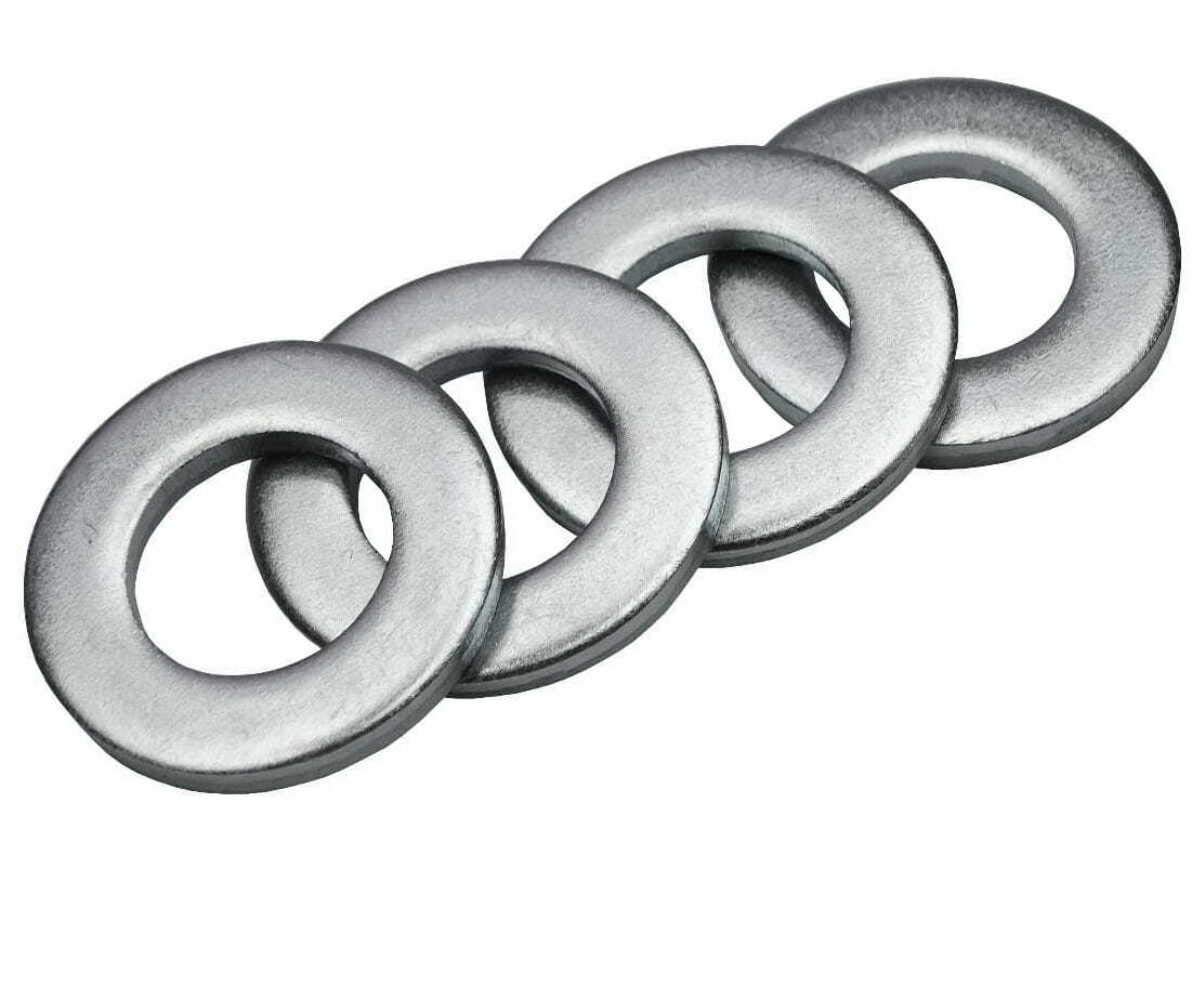
Custom Washers Manufacturer: Flat, Spring, Lock, Tab and Belleville Washers Made to Drawing
A washer is the smallest, cheapest-looking part on a bill of materials, and the one most often left to the buyer to "source locally". On a bench that is fine. On a joint that has to hold clamp load for ten years, seal a flange, or lock a nut against vibration, the washer geometry, material and hardness decide whether the fastener actually does its job. A soft commercial washer under a heavy nut embeds. The wrong spring washer on a vibrating equipment mount back-offs. A Belleville stack selected without the right load-deflection curve bottoms out on the first thermal cycle.
Yuanpai manufactures custom washers to drawing and to standard dimensions for EPC contractors, equipment OEMs and distributors worldwide, working to ISO and EN standards as primary, with ASTM materials supplied wherever the customer's drawing calls them up. We make flat washers, spring lock washers, serrated lock washers, tab washers and coned-disc (Belleville) washers — in carbon steel, spring steel, stainless and non-ferrous materials. This guide covers the washer types buyers actually specify, the material and finish choices, and the dimensions an RFQ should carry to come back complete the first time.
Yuanpai Custom Washer Quick Reference
- Types: flat, spring lock, serrated (external / internal), tab, Belleville (coned disc)
- Primary standards: ISO 7089 / 7090 / 7091 flat washers, DIN 127 spring, DIN 6797 / 6798 serrated, DIN 462 / 463 tab, DIN 2093 Belleville
- Materials: carbon steel, spring steel (C72 / 65Mn / 51CrV4), stainless A2 / A4 (ISO 3506), brass, copper
- Customer-specified: ASTM F436 hardened washers; customer-specified washer requirements paired with ASTM A194 nut assemblies where applicable
- Sizes: M3 to M64 standard; custom OD / ID / thickness to drawing
- Finishes: plain, zinc plated, hot-dip galvanized (ISO 10684), zinc flake (ISO 10683), black oxide
- Documentation: EN 10204 3.1 per heat; hardness reports on hardened and spring washers
- Production: stamping / progressive die, heat treatment for spring and Belleville, plating in-house
1. Why a Washer Is Not a Commodity
A washer does three distinct jobs, and the geometry that does one of them is wrong for the others:
- Bearing. A flat washer spreads the nut or bolt-head load over the connected part and prevents embedding. This is about area and hardness, not about locking.
- Locking. A spring or serrated washer resists the bolt loosening under vibration and transverse load. It introduces a prevailing tension or a tooth bite, at the cost of some bearing flatness.
- Spring / take-up. A Belleville washer acts as a spring, maintaining clamp load as the joint relaxes, contracts or thermally cycles. It is selected from a load-deflection curve, not picked by size.
The mistake we see most is ordering "washers" without saying which job. A spring lock washer is not a flat washer with a gap; it should not be used to spread a heavy preload, and a flat washer should not be expected to lock a vibrating joint. Stating the washer type on the RFQ is the single thing that prevents the wrong part being quoted.
2. Flat Washers: ISO 7089, ISO 7090 and DIN 125
The flat washer is the default bearing washer. Three dimensions dominate:
| Washer | Standard | Series | Typical use |
|---|---|---|---|
| Normal flat washer | ISO 7089 | Normal, flat faces | General assembly, under bolt head and nut |
| Chamfered flat washer | ISO 7090 | Normal, one face chamfered | Under nuts / heads where the chamfer clears the radius |
| Large flat washer | ISO 7091 | Large OD | Soft or thin materials, where bearing area must grow |
| Thin / small series | ISO 7092 | Smaller OD, thinner | Confined stack height, light assemblies |
| Legacy reference | DIN 125 | Equivalent to ISO 7089 / 7090 | Widely called up on European and MENA drawings |
Flat washers are supplied in bright carbon steel, zinc-plated, stainless or hardened. The hardened distinction matters: a commercial bright flat washer is soft and embeds under high preload, whereas a hardened structural washer (for example to ASTM F436 where the drawing calls it up, or to the EN 14399 structural washer band) is heat-treated to a hardness that resists embedment on preloaded joints. On general low-load assembly, the commercial washer is the right, economic choice; on a preloaded structural or flange joint, the washer hardness must match the nut and bolt.
A related structural washer buyers sometimes ask for is the direct tension indicator (DTI) washer — a compressible, stamped washer with protrusions that collapse as the bolt is tensioned, so the erector can verify preload with a feeler gauge instead of relying on torque alone. These are supplied to ASTM F959 / F959M where the structural specification calls them up, alongside the matched bolt, nut and hardened washer; they are a preload-verification device, not a generic flat washer, and should be specified as such on the RFQ.
Custom flat washers go beyond the standard series: over-sized "fender" washers for thin sheet, extra-thick washers for soft aluminium or plastic housings, stepped or shoulder washers, and insulating washers in nylon or fibre for electrical isolation. These are drawn parts, and the OD, ID and thickness are stated on the customer drawing.
3. Spring and Serrated Lock Washers
A plain nut will back off under vibration — that is the physics of a free-running thread. Where the joint sees cyclic load, transverse slip or thermal cycling, a lock washer or prevailing-torque nut is required. On the nut side we cover the prevailing-torque nut types in our hex nuts and lock nuts guide; the washer-side options are:
| Lock washer | Standard | How it works | Notes |
|---|---|---|---|
| Single-coil spring lock washer | DIN 127 | Split ring, compressed under the nut; tries to push the nut up | Economical for light, steady load; limited effectiveness under severe transverse vibration, not recommended as the primary locking device |
| Curved / wave spring washer | DIN 128 | Curved wave, light spring take-up | Low-load, anti-rattle assemblies |
| External serrated lock washer | DIN 6797 | Radial teeth bite into nut face and surface | Teeth should bear on a flat surface; good for medium vibration |
| Internal serrated lock washer | DIN 6798 | Serrations inside the bore | Smaller OD visible; used where external teeth would show |
| Tab washer | DIN 462 / 463 | A tab bent up against a nut face or shaft | Positive mechanical lock; removed and replaced on service |
Two cautions buyers should build into the spec. First, serrated and spring washers under a rotating nut score the bearing surface, which changes friction — they are not used on calibrated preloaded structural joints. Second, a spring lock washer that is fully flattened under the nut has stopped working; on a high-preload joint the washer collapses and you are back to a free-running nut. On severe transverse vibration — the Junker-style slip that loosens a free-running thread — a split DIN 127 washer provides only limited resistance and should not be relied on as the primary locking device. For serious vibration work, the locking method is usually a prevailing-torque nut, a mechanical tab lock, or a direct-tension indicator / washer-based locking system rather than a simple split washer.
4. Tab Washers: Positive Mechanical Locking
Tab washers are the most positive lock on this list because they do not rely on spring tension. A tab washer is a flat washer with one or more tabs; after the nut is tightened, a tab is bent up against a flat on the nut (or against a shaft shoulder), so the nut cannot rotate. DIN 462 is the standard inside tab washer for nuts on shafts; DIN 463 covers external tab / multi-tab washers for larger assemblies.
Typical uses: shaft-mounted bearings and pulleys, nut retention on large bolted equipment where vibration is severe, and any joint where the nut must be positively prevented from turning regardless of preload loss. Tab washers are single-use — the tab is bent over on installation and bent back for removal, which work-hardens the tab — so service schedules usually call for new tab washers on reassembly.
Because they are bent to the geometry of the nut flat or the shaft, tab washers are often made to the drawing rather than to a catalogue size. The drawing should state the bore, the outer diameter, the tab width, the tab bend direction and the material and finish.
5. Belleville (Coned Disc) Washers
A Belleville washer is a coned disc spring: a shallow cone of spring steel that deflects under axial load. Unlike every washer on this list, it is selected from a load-deflection curve, not by nominal thread size. Its job is to maintain clamp load as the joint relaxes — gasket creep, thermal contraction, bolt elongation under thermal cycling — by providing a controlled spring force over a small deflection.
| Property | Typical value / note |
|---|---|
| Standard | DIN 2093 (coned disc springs) |
| Material | Spring steel C72 / 65Mn, or 51CrV4 for higher temperature |
| Deflection | Small, controlled; selected from the load-deflection chart |
| Stacking | Single, in series (adds deflection) or in parallel (adds load) |
| Finishes | Black oxide, zinc, or stainless for corrosion service |
Belleville washers are used on bolted joints that must retain preload despite relaxation: pump and valve flanges, high-temperature pipe joints, electrical busbars, and bolted equipment where differential thermal expansion would otherwise loosen the bolt. They are not general locking washers — a mis-selected Belleville stack either bottoms out immediately (no spring travel left) or never compresses the joint (too stiff). Specifying a Belleville stack is an engineering exercise: the joint's relaxation and thermal deflection must be matched to the washer stack rate, which is why we ask for the joint load and deflection rather than just a thread size.
6. Materials and Finishes
Washer material is chosen to match the bolt and the environment. The range we ship:
| Material | Standard | Typical use |
|---|---|---|
| Low-carbon steel, bright / zinc plated | Manufactured to customer specification or the relevant washer standard (e.g. ISO 7089 / 7090), commercial | General assembly, indoor, corrosion plated |
| Spring steel (C72 / 65Mn) | DIN 17223 type | Spring lock and Belleville washers, heat-treated |
| Alloy spring steel (51CrV4) | EN 10089 type | High-temperature Belleville and heavy spring washers |
| Stainless A2 / A4 | ISO 3506 | Corrosive, outdoor, food and marine-adjacent service |
| Brass / copper | Customer spec | Electrical conductivity, grounding, soft bearing |
| Hardened alloy (ASTM F436 type) | ASTM F436, customer-specified | Preloaded structural and flange joints |
Finishes follow the bolt: plain or black oxide for indoor, zinc plating for general corrosion protection, hot-dip galvanizing per ISO 10684 for external structural work, and zinc flake per ISO 10683 where low hydrogen and controlled friction matter. On HDG work, the washer bore is sized to clear the thicker coated bolt; on zinc-flake and PTFE-coated sets, the thin coating does not materially change the bore.
Because washers sit between fastener families, they are commonly shipped alongside the matching threaded rods and studs and hex nuts on one packing list — so a complete joint, not just one part, arrives on the same mill certificate.
7. Manufacturing Route
Most washers start as strip and are blanked on progressive dies, with the exception of large custom and Belleville parts:
- Strip control — certified carbon, spring or stainless strip, with mill chemistry verified on receipt.
- Blanking / forming — flat and lock washers blanked from strip; spring washers coiled or formed; Belleville washers punched and coned.
- Heat treatment — spring and Belleville washers hardened and tempered to the required spring properties; hardness checked per lot.
- Secondary operations — chamfering, deburring, tab bending to drawing, serration forming.
- Finishing — zinc plating, HDG, zinc flake or black oxide in controlled lines.
- Inspection — bore and OD gauging, thickness, hardness on hardened parts, visual and plating thickness where coated.
- Packing — counted, boxed and labelled to the PO, with lot traceability back to the strip heat.
Manufacturing capability at a glance. Buyers qualifying a washer supplier usually want the machine and inspection envelope in numbers rather than adjectives. Typical in-house capability:
| Capability | Range / equipment |
|---|---|
| Blanking / stamping press capacity | Mechanical and progressive presses from roughly 16 t to 400 t |
| Washer strip thickness handled | About 0.3 mm up to 12 mm flat washer; heavier custom and Belleville parts to drawing |
| Maximum outside diameter | Standard flat washers to M64 / OD ~120 mm; custom punched washers up to roughly 300 mm OD |
| Typical production capacity | Several million standard washers per month across the press lines; custom / Belleville lots quoted per drawing |
| Heat treatment | In-house continuous furnace and batch furnace for spring and Belleville washers, hardness-banded per lot |
| Inspection equipment | Vernier / micrometer gauges for OD, ID and thickness; Rockwell and Vickers hardness testers; thread / ring gauges; salt-spray chamber for coating verification; optical comparator for drawn geometry |
The exact envelope for a custom part is confirmed on the RFQ — send the drawing and we confirm whether it runs on an existing die or needs new tooling.
For truly custom geometry — non-standard OD/ID ratios, stepped bores, special materials, small hard-to-find sizes — we work from the customer's drawing and confirm tooling before production.
8. Supplier Evaluation Card
Use this card when comparing custom washer suppliers. The points below reflect what OEM and EPC buyers typically ask for on qualification.
| Evaluation point | What to ask the supplier | Why it matters |
|---|---|---|
| Type range | Can they make flat, spring, tab and Belleville in one place? | Splitting washer types across suppliers loses lot control |
| Heat treatment | Is spring / Belleville heat treatment in-house, with hardness reports? | A spring washer without controlled hardness does not spring |
| Hardened capability | Can they supply hardened washers matched to preloaded bolts? | Soft washers embed and relax preload |
| Custom tooling | Can they blank non-standard OD/ID from a drawing? | Catalogue washers cannot meet special geometry |
| Material scope | Do they hold stainless, spring steel and non-ferrous strip? | Avoids sourcing the same part across multiple mills |
| Finish control | Is plating / zinc flake in-house? | Subcontracted finish often loses thickness control |
| Traceability | Does the lot trace back to a mill heat? | Auditable supply for regulated equipment |
| Certificate format | 3.1 in English, matching PO line items? | OEM inspectors reject non-conforming cert packs |
| Sampling | Can they send a sample before production? | Geometry and bore fit confirmed before the run |
9. RFQ Dimensions: What to Send to Quote a Custom Washer
Washer RFQs come back with clarifying questions most often because only a thread size is given. Send the following on the first request:
| RFQ field | Example | Notes |
|---|---|---|
| Washer type | Flat / spring / serrated / tab / Belleville | Which job the washer does |
| Bore (ID) | e.g. 10.5 mm for M10 | Clearance over the bolt shank |
| Outside diameter | e.g. 20 mm, or 30 mm for large series | Bearing area |
| Thickness | e.g. 2 mm | Critical on stack-height designs |
| Standard / drawing | ISO 7089, or customer drawing | Drawings drive custom geometry |
| Material | Carbon steel, C72 spring, A4 stainless, 51CrV4 | Match the bolt and environment |
| Hardness requirement | e.g. hardened to HV 300 min, or F436 | Required on preloaded joints |
| Finish | Zinc, HDG ISO 10684, zinc flake, plain | Match the bolt coating |
| Quantity | e.g. 50,000 pcs | Sets vs loose washers changes packing |
| Special features | Chamfer, tab bend direction, insulation | Drawn details |
| Certification | EN 10204 3.1; hardness report on spring / hardened | Agreed at quotation |
Send these fields — or attach the drawing — and we return a complete quotation with material, hardness, finish and documentation scoped to the part, without a follow-up round trip.
10. Common Washer Selection Mistakes
- Ordering "washers" without the type. A spring washer is not a flat washer; the wrong type is guaranteed.
- Soft washers under preloaded nuts. Commercial bright washers embed; specify hardened on structural and flange joints.
- Serrated washers on calibrated preload joints. The teeth change friction and score the surface.
- Spring washers fully flattened. A flattened split washer has lost its locking action.
- Re-using tab washers. The tab is bent over in service; bent back tabs are work-hardened and fail. Use new tabs.
- Belleville by thread size only. A Belleville must be selected from the load-deflection curve for the joint.
- Ignoring the matched bolt finish. A zinc-plated washer on an HDG bolt can galvanic- and fit-mismatch; spec the finishes together.
FAQ
Q: What is the difference between a flat washer and a spring lock washer? A: A flat washer spreads the bearing load and prevents embedding; it does not lock the joint. A spring lock washer (DIN 127) supplies a small spring tension to resist backing-off under vibration. They do different jobs and are specified separately.
Q: Do you make washers to a custom drawing? A: Yes. Non-standard OD, ID and thickness, stepped washers, special tab geometries and custom Belleville stacks are produced from the customer's drawing, with material and finish matched to the joint.
Q: Can you supply ASTM washers? A: We work primarily to ISO and EN standards, but supply ASTM F436 hardened washers and customer-specified washer requirements paired with ASTM A194 nut assemblies wherever the drawing calls them up, with certificates referencing the applicable standard. Note that ASTM A194 is a nut specification, not a washer specification — the washer itself is supplied to the drawing or to the relevant washer standard (such as F436) selected to suit the A194 nut and bolt.
Q: Which washer should I use on a vibrating joint? A: A simple split spring washer is a light-duty answer. On serious vibration, the more reliable route is a prevailing-torque nut or a positive tab lock, rather than relying on a split washer alone.
Q: Are stainless washers available in A2 and A4? A: Yes. A2 (304) and A4 (316) stainless washers are supplied per ISO 3506 for corrosive and outdoor service, matched to stainless bolts.
Q: What certificates are included? A: EN 10204 3.1 per heat, with chemistry and mechanical properties, plus hardness reports on hardened and spring washers. 3.2 with third-party witness is arranged where the project requires.
Request a Quotation
Send the RFQ dimensions above — or attach the washer drawing — and we will confirm material, hardness, finish and the documentation pack within one working day. For projects mixing standard and custom washers, send the full washer BOM and we will quote every line.
Email: sales@ypfasteners.com
We manufacture flat, spring, lock, tab and Belleville washers as part of complete fastener packages, with rods, studs and hex nuts available on the same packing list, and the test and certificate scope agreed at quotation.
Related guides: Custom Fastener Manufacturer Center, Threaded Rods & Studs Manufacturer, Hex Nuts & Lock Nuts Manufacturer