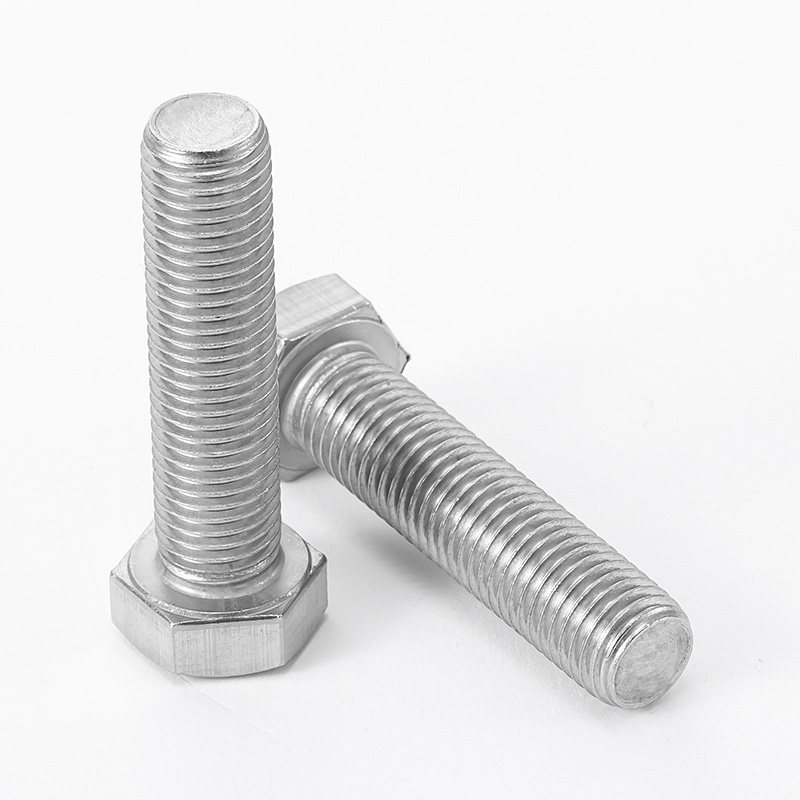
Most fastener materials solve one problem well. Carbon and alloy steels hold high strength but corrode. Austenitic stainless steels resist general corrosion but are weak, prone to chloride stress corrosion cracking, and creep at temperature. Nickel alloys like Inconel and Hastelloy resist severe corrosion but cost several times the price per kilogram. Duplex stainless steels sit between those groups: they combine roughly twice the yield strength of 316, chloride stress corrosion resistance that austenitic stainless cannot match, and a price point well below super duplex or nickel alloys.
Duplex 2205 (UNS S31803 / the tighter-composition UNS S32205, EN 1.4462 / X2CrNiMoN22-5-3) is the most widely used duplex grade in the world. It appears in chemical processing, desalination, marine and offshore hardware, pulp and paper, oil and gas piping, and structural chloride service where 316 would corrode but super duplex would be over-specified.
As a custom fastener manufacturer and supplier, Yuanpai produces 2205 bolts, studs, nuts, washers and turned-to-drawing special fasteners for OEMs, EPC contractors and equipment manufacturers across Europe, the Middle East, Southeast Asia, Australia and the Americas. We work to ISO and EN material standards as primary, with ASTM A276 and ASTM A479 bar specifications accepted whenever the customer's drawing calls them up. This guide explains what 2205 is, how it differs from 316 and super duplex 2507, how the manufacturing route differs from ordinary stainless, and the dimensions an RFQ should carry.
For the higher-alloy sibling, see our super duplex 2507 fastener guide. For the austenitic baseline it is often chosen over, see our stainless steel fastener selection guide.
Yuanpai Duplex 2205 Quick Reference
- Materials: UNS S31803, UNS S32205, EN 1.4462 / X2CrNiMoN22-5-3
- Family: Austenitic-ferritic duplex stainless (~50/50 phase balance)
- Bar / product standards (primary): EN 10088-3 (stainless bar); EN 1.4462
- Customer-specified references: ASTM A276 (bar), ASTM A479 (bolting bars), ASTM A182 (forgings)
- Finished fastener product (US): ASTM F593 (bolts), ASTM F594 (nuts); A193 / A320 grade mapping per project spec
- Condition: Solution annealed and quenched (~1020–1100 °C)
- Tensile strength: Min 620–700 MPa (typical 655–795 MPa)
- Yield strength Rp0.2: Min 450–550 MPa
- PREN: Approximately 34–38
- Documentation: EN 10204 3.1, PMI, hardness, impact tests on request; 3.2 with third-party witness
1. What Makes a Duplex Steel "Duplex"?
Austenitic stainless steels (304, 316) have a face-centered-cubic microstructure. Ferritic stainless steels (430, 446) have a body-centered-cubic microstructure. Duplex 2205 is deliberately alloyed and heat treated so that roughly half the grains are austenite and half are ferrite.
That phase balance is the whole engineering point:
- The ferrite phase contributes higher strength, yield, and resistance to chloride stress corrosion cracking.
- The austenite phase contributes toughness, ductility and general corrosion resistance, and keeps the alloy from being brittle like a fully ferritic stainless.
- The addition of nitrogen (about 0.14–0.20%) boosts strength and pitting resistance without upsetting the phase balance.
The result is an alloy with roughly double the yield strength of 316 (about 450 MPa minimum versus 210 MPa for 316 annealed) and a PREN around 34–38, well above 316's ~24. It is not as strong or as corrosion-resistant as super duplex 2507 (PREN 42–45), and it is far cheaper.
Typical chemistry
| Element | Typical range (wt%) | Role |
|---|---|---|
| Chromium (Cr) | 21.0–23.0 | Passive film, pitting resistance |
| Nickel (Ni) | 4.5–6.5 | Austenite stability, SCC resistance |
| Molybdenum (Mo) | 2.5–3.5 | Pitting and crevice resistance |
| Nitrogen (N) | 0.08–0.20 | Strength, pitting resistance |
| Manganese (Mn) | ≤ 2.0 | Controlled |
| Silicon (Si) | ≤ 1.0 | Controlled |
| Carbon (C) | ≤ 0.030 | Low, to limit carbide precipitation |
| Iron (Fe) | Balance | Matrix |
S31803 was the original specification; S32205 is the later, tighter-composition version with narrower Ni and Mo bands. On a drawing today, S32205 is generally the preferred grade because of its tighter chemistry control. The two are not a blanket drop-in equivalence: where a project specification names one UNS, the bar, finished fastener, mill certificate and PMI must match that number, and any substitution between S31803 and S32205 requires explicit project engineering approval rather than being assumed interchangeable.
2. Mechanical Properties Compared With Common Fastener Alloys
The number that changes the joint design is yield strength. A 2205 bolt has roughly double the yield strength of a standard annealed 316 bolt, which means it can in principle be tensioned to a higher allowable preload. In practice the actual clamp load also depends on thread and under-head friction, the preload method (torque, tensioner or stretch), bolt diameter and the material's proof-load margin, so the joint calculation — not the yield number alone — sets the working clamp load. That higher allowable preload margin is why duplex appears on flanges and structural connections where the bolt load governs.
| Property | 316L (A4-70) | Duplex 2205 | Super Duplex 2507 |
|---|---|---|---|
| Tensile strength | 700 MPa min | 620–795 MPa | 760–800 MPa min |
| Yield strength Rp0.2 | 450 MPa min | 450–550 MPa min | 550 MPa min |
| PREN | ~24 | ~34–38 | ~42–45 |
| Chloride SCC resistance | Moderate | Good | Very good |
| Relative cost | 1x | ~1.5–2x | ~2.5–3x |
| Typical service | General corrosion | Chloride, marine, process | Severe seawater, sour chloride |
Two practical limits to state up front:
- Temperature ceiling. Duplex 2205 is generally used between about -40 °C and 250–300 °C. Above ~300 °C, undesirable intermetallic phases (sigma, chi) can precipitate and embrittle the alloy. It is not a high-temperature bolting material — for that you move to 310S, Inconel 718 or other heat-resistant grades.
- Low-temperature toughness. The ferrite phase gives 2205 a ductile-to-brittle transition; it is not a cryogenic steel. For sub-zero service below about -40 °C, check impact requirements with the project specification.
3. Typical Applications of Duplex 2205 Fasteners
2205 is specified where the environment crosses a threshold that 316 cannot, but where super duplex or nickel alloys would be over-specified:
- Chemical processing. Flange bolting on chloride-handling piping, heat exchanger bolting, pump and valve hardware where process fluids contain chlorides, acids or brackish water.
- Desalination and seawater. Brackish water piping, reverse-osmosis equipment, intake and outfall hardware — positions that are not continuous high-velocity seawater but see significant chloride exposure.
- Marine and offshore. Splash-zone handrails, walkway bolting, cable tray supports, platform equipment mounts where 316 would pit but super duplex is unnecessary.
- Oil and gas. Produced-water handling, water injection piping, gathering line flanges within NACE MR0175 limits; wellhead and sour service require project-specific approval and hardness control.
- Pulp, paper and power. Scrubber hardware, FGD (flue gas desulfurization) bolts, cooling tower structure, coastal power plant bolting.
- Structural and architectural chloride service. Coastal building facades, bridge hardware, swimming-pool and water-park structures where chloride-laden air would corrode carbon or 304 steel.
The selection logic is consistent: if the joint sees chlorides and needs strength, 2205 is the default first duplex grade. Move up to 2507 when pitting/crevice conditions become severe or temperatures rise; move to 316L when strength is not needed and cost is the priority.
4. Manufacturing: Why 2205 Is Not Just "Better 316"
Duplex fasteners look like stainless fasteners in a bin. They are produced differently, and the manufacturing controls are what separate a certified 2205 bolt from a disappointing one.
4.1 Raw material and phase balance
The ferrite/austenite ratio is controlled at the mill and is not something a fastener maker can correct later. Incoming bar is checked by PMI (XRF) for chemistry, and where the project requires it, ferrite content is verified by ferritscope or metallography. A bar with the wrong phase balance can age to brittle or soft properties no machining can fix.
4.2 Solution annealing
Duplex 2205 bar and forgings are supplied solution annealed at roughly 1020–1100 °C and then rapidly cooled (water quench or fast air cool). The anneal dissolves intermetallic phases and sets the balanced microstructure. Slow cooling through the 600–900 °C range is what causes sigma-phase precipitation and embrittlement — which is why welding, thermal cutting and any post-machining heat cycle have to be controlled.
4.3 Machining
2205 machines harder than 316. Cutting speeds are lower, tool wear is higher, and the alloy work-hardens. A shop that runs 2205 the way it runs 304 will produce poor surface finishes and short tool life. Rigid setups, sharp carbide tooling and controlled feeds are required.
4.4 Thread production
Threads are typically rolled after solution annealing for fatigue performance, or cut for short runs and large diameters. Thread gauging (GO/NO-GO) is performed on every lot. Like other stainless alloys, 2205 can gall during dry assembly, so thread surface condition matters.
4.5 Galling
Duplex grades can gall when identical surfaces slide under load, as can austenitic stainless. A 2205 bolt into a 2205 nut assembled dry carries a high risk of seizure. Assembly calls for a high-quality anti-seize compound and controlled torque. Nut matching should stay within the same alloy family; do not pair a 2205 stud with a lower-grade austenitic nut, or the nut becomes the stripping point.
For smaller high-volume parts where cold heading is the route rather than CNC turning, see our custom cold heading manufacturing guide. For the broader fastener manufacturing process from wire to finished bolt, see how bolts are made.
5. Duplex 2205 vs Super Duplex 2507 vs 316
Buyers comparing the three usually want to know which one to draw. They are not drop-in replacements.
| Dimension | 316L (A4-70) | Duplex 2205 | Super Duplex 2507 |
|---|---|---|---|
| Microstructure | Austenitic | Duplex (~50/50) | Super duplex (~50/50, higher Cr/Mo/N) |
| Tensile | 700 MPa | 620–795 MPa | 760–800 MPa+ |
| Yield | 450 MPa | 450–550 MPa | 550 MPa+ |
| PREN | ~24 | ~34–38 | ~42–45 |
| Chloride SCC | Susceptible above ~60 °C | Resistant to higher temperatures | Very resistant |
| Cost index | 1x | ~1.5–2x | ~2.5–3x |
| Welding | Easy | Needs controlled filler and heat input | More demanding |
| Typical ceiling for service | Atmospheric chloride | Brackish, moderate chloride | Seawater, severe chloride |
Selection rule of thumb:
- Choose 316L when general corrosion is the only concern, strength is moderate, and cost matters.
- Choose 2205 when chloride exposure plus higher clamp load is the problem, and the environment is brackish or moderately corrosive.
- Choose 2507 when continuous seawater, high-temperature chloride, or sour-service conditions push past 2205's margin.
For sour oil and gas service specifically, both 2205 and 2507 are referenced in NACE MR0175 / ISO 15156 with defined environmental and hardness limits. The project specification governs, and hardness control becomes part of the certification.
6. RFQ Dimensions for Duplex 2205 Fasteners
A 2205 inquiry that says only "2205 bolts" will return a range of prices for different products. State the following:
- Material and UNS: UNS S31803 or UNS S32205, EN 1.4462. State which UNS.
- Product standard: EN 10088-3 bar primary; ASTM A276 or ASTM A479 called up on the drawing where the customer's project references them. For finished fasteners in US service, ASTM F593 (bolts) and ASTM F594 (nuts) are the fastener-product standards to call up. US buyers familiar with alloy- and austenitic-stainless bolting under ASTM A193 (high-temperature) / A320 (low-temperature and sour) should note that duplex 2205 is not a standard A193/A320 grade in the way B7 or B8M are; it is normally specified via F593/F594 on A276/A479 bar, so confirm the project's preferred grade mapping before ordering.
- Product and geometry: bolt, stud, nut, washer, or special turned part; drawing with dimensions, thread form, thread class, head style, length, chamfer, markings.
- Condition: solution annealed and quenched; hardness range if specified.
- Mechanical requirements: minimum tensile and yield; impact test if low-temperature service applies.
- Ferrite balance: if the drawing calls for a ferrite range (typically 40–60%), state it.
- Thread production: rolled or cut.
- Anti-seize: whether supplied pre-lubricated.
- Tests and documents: EN 10204 3.1 MTC, PMI, hardness report, dimensional records; 3.2 third-party witness on request.
- Marking: UNS grade, heat number, maker's mark on each fastener.
Supplier Evaluation Card
| Dimension | What to verify | Why it matters |
|---|---|---|
| Material traceability | Mill cert per heat, PMI on incoming bar, heat number on parts | 2205 looks like 316 and 2507; chemistry distinguishes them |
| Phase balance | Ferrite content check, anneal record per lot | Wrong ferrite ratio means soft or brittle hardware |
| Annealing control | Qualified furnace, rapid quench, chart records | Slow cooling causes sigma-phase embrittlement |
| Machining capability | CNC turning with duplex experience, controlled speeds | Poor machining introduces work-hardened surface layers |
| Thread capability | Rolled threads or controlled cut threads, gauge records | Galling and fatigue depend on thread root condition |
| Documentation discipline | 3.1 MTC, PMI, hardness, dimensional, heat charts bundled | EPC and OEM QA stops missing certs |
| Third-party inspection | SGS, BV, TÜV or customer inspector on request | Critical process and offshore projects require witnessed release |
| MOQ flexibility | One-off custom parts to multi-lot production runs | OEM spares and prototypes are small orders |
| Lead-time realism | Bar availability + machining + inspection quoted up front | Duplex bar lead times differ from standard stainless |
| Standards flexibility | ISO/EN primary, ASTM A276/A479 mapped to drawing | Multi-standard global customers need both references |
Quick-Reference Specification Table
| Item | Specification |
|---|---|
| Materials | UNS S31803, UNS S32205, EN 1.4462 / X2CrNiMoN22-5-3 |
| Alloy type | Austenitic-ferritic duplex stainless |
| Phase balance | ~50% ferrite / ~50% austenite |
| Bar standard (primary) | EN 10088-3 |
| Customer-specified references | ASTM A276, ASTM A479, ASTM A182 |
| Finished fastener product (US) | ASTM F593 (bolts), ASTM F594 (nuts); A193 / A320 mapping per project spec |
| Condition | Solution annealed and quenched (~1020–1100 °C) |
| Tensile strength | 620–795 MPa typical |
| Yield strength Rp0.2 | 450–550 MPa typical |
| PREN | ~34–38 |
| Service temperature | Approximately -40 °C to 250–300 °C |
| Thread systems | Metric ISO per drawing; UNC/UNF on request |
| Assembly | Anti-seize required; matched alloy nuts; controlled torque |
| Typical products | Bolts, studs, nuts, washers, custom turned parts |
| Applications | Chemical processing, desalination, marine, oil/gas, structural chloride |
| Documentation | EN 10204 3.1, PMI, hardness, dimensional; 3.2 on request |
Related Guides
Continue exploring custom fastener materials and manufacturing:
- Custom Fastener Manufacturer and Supplier — Yuanpai Center
- Super Duplex 2507 Fasteners for Severe Seawater Service
- Stainless Steel Fastener Selection: 304 vs 316
- Inconel Alloy Fasteners — 625, 718 and Monel Family
- Custom Cold Heading Manufacturing for High-Volume Precision Parts
- Fastener RFQ Checklist: 12 Fields for a Usable Quote
FAQ
What is duplex 2205 used for?
Duplex 2205 is used where chloride corrosion and higher bolt strength are both required. Typical fastener applications include chemical process flanges, desalination and brackish-water piping, marine and offshore splash-zone hardware, produced-water oil and gas piping, FGD scrubber bolts and coastal structural connections.
Is 2205 the same as 316 stainless?
No. 316 is an austenitic stainless with lower yield strength and lower pitting resistance. 2205 is a duplex austenitic-ferritic stainless with roughly double the yield strength and PREN around 34–38, giving better chloride stress corrosion resistance. They are not drop-in replacements; the joint design changes.
What is the difference between S31803 and S32205?
S31803 is the original duplex 2205 specification. S32205 is the later, tighter-composition version with narrower nickel and molybdenum bands and is generally the preferred grade today. They are not a blanket drop-in equivalent: the UNS number should be stated on the drawing and matched on the mill certificate and PMI report, and any substitution between S31803 and S32205 requires project engineering approval.
Can 2205 bolts be used in seawater?
2205 performs well in brackish and moderately chloride environments, including many seawater piping and splash-zone positions. For continuous high-velocity seawater or severe crevice service, super duplex 2507 or nickel alloys provide a larger corrosion margin. The actual service temperature and chloride concentration should be reviewed before specifying.
Do duplex 2205 fasteners gall?
Yes. Like other stainless alloys, 2205 can gall during dry assembly, and it has a particular reputation for galling under identical-surface high-load contact. Never assemble 2205-to-2205 threads dry. Use a compatible anti-seize compound, controlled torque, and nuts of the same alloy family.
What temperature range is 2205 suitable for?
Duplex 2205 is generally used between about -40 °C and 250–300 °C. Above 300 °C, intermetallic sigma-phase precipitation can embrittle the alloy. It is not a high-temperature bolting material and is not suitable for cryogenic service without impact testing.
What certificates come with 2205 fasteners?
A standard package includes an EN 10204 3.1 mill certificate, PMI report, hardness report, dimensional inspection and heat traceability. Impact tests and ferrite content verification can be added, and third-party 3.2 witness inspection is available for critical process and offshore projects.
Talk to Our Engineering Team
Send your 2205 bolt, stud, nut or special-fastener drawing, together with the service environment (chloride level, temperature, whether sour service applies) and the required documentation level. Our engineering team will confirm material, production route, annealing and inspection points before release.
Yuanpai regularly supplies prototype batches, spares orders and multi-lot production runs to equipment OEMs and EPC contractors. We hold qualified 2205 bar through approved mills, run CNC turning with duplex-dedicated setups, and issue a complete documentation pack before shipment — mill cert, PMI, hardness, dimensional and heat records — rather than emailing certificates piecemeal after the customer asks. Lead time and documentation scope are quoted on the RFQ, not added later.
- Email: engineering@yuanpai-fasteners.com
- Include the drawing, service environment and required cert level in your message, and we will come back with material confirmation, production route and lead time.