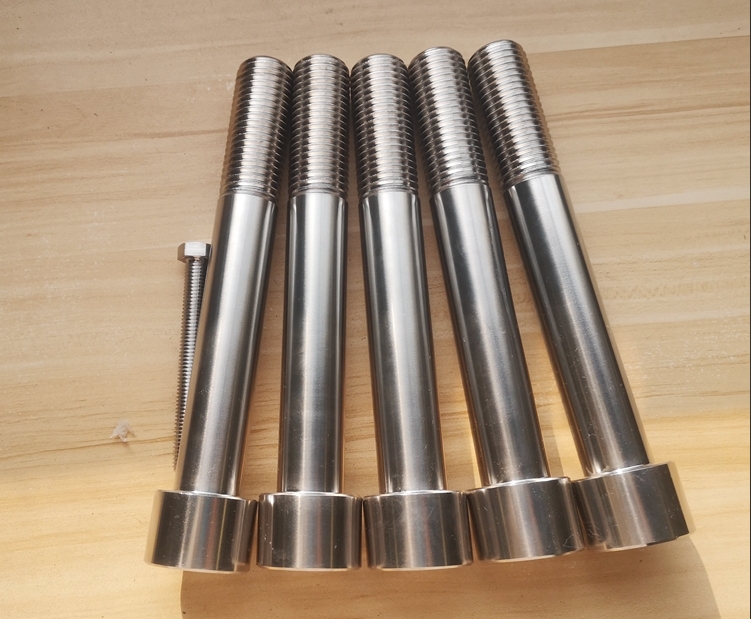
Most fastener materials are chosen for one of two reasons: they resist corrosion, or they hold their strength at room temperature. Inconel 718 (UNS N07718, Werkstoff 2.4668) is chosen for a third reason — it holds useful tensile, fatigue and creep strength at temperatures where carbon steel, stainless steel and even most austenitic alloys have softened or degraded. That is why 718 studs, bolts, nuts and special fasteners appear in gas turbine casings, compressor sections, aerospace engine mounts, downhole high-pressure tools, and in high-temperature exhaust and boiler hardware where the operating temperature runs to 600 °C and beyond.
As a custom fastener manufacturer and supplier, Yuanpai produces Inconel 718 bolts, studs, nuts, washers and turned-to-drawing special fasteners for OEMs, tier-1 suppliers and EPC contractors across Europe, the Middle East, Southeast Asia, Australia and the Americas. This guide explains what makes 718 different from 625, how the precipitation-hardening route changes manufacturing, what temperature and strength numbers to expect, and what documentation an aerospace or turbine customer should demand before approval.
We manufacture to customer drawings and applicable ISO, EN, DIN and UNS material references, with ASTM product standards accepted when the customer's drawing calls them up. For US aerospace programs, AMS 5662 covers Inconel 718 bar and fasteners in the solution-annealed-and-aged condition; where the drawing calls up AMS 5662, the heat-treatment and inspection requirements follow that specification rather than ASTM B637.
For the wider nickel alloy family, see our Inconel alloy fastener guide. For parts where cold heading is the production route rather than CNC turning, see our custom cold heading manufacturing guide.
Yuanpai Inconel 718 Quick Reference
- Material: Inconel 718 / UNS N07718 / Werkstoff 2.4668
- Material family: Ni-Fe-Cr precipitation-hardening superalloy
- Strengthening mechanism: Gamma-prime (γ') and gamma-double-prime (γ'') precipitates
- Typical supply condition: Solution annealed + aged (aged condition for fasteners)
- Service temperature range: Up to ~650 °C continuous; short excursions to ~700 °C
- Tensile strength (aged): Typically ≥1240 MPa
- Yield strength (aged): Typically ≥1030 MPa
- Product standards (customer-specified): ASTM B637 (bar and forgings), ASME SB637; AMS 5662 for US aerospace
- Documentation: EN 10204 3.1, PMI, heat-treatment records, hardness, mechanical test reports
1. What Is Inconel 718, and Why Is It Different From 625?
Inconel 625 and Inconel 718 are both nickel-based superalloys. They look similar in a catalog. They are engineered for completely different jobs.
625 is solid-solution strengthened. Its strength comes from chromium, molybdenum and niobium dissolved in the nickel matrix. It is supplied soft (solution annealed) and is chosen for corrosion resistance — seawater, sour service, chemical processing.
718 is precipitation hardened. It is a nickel-iron-chromium alloy with niobium and molybdenum, and it gains its strength from a controlled aging heat treatment that precipitates gamma-prime (Ni₃(Ti,Al)) and gamma-double-prime (Ni₃Nb) phases throughout the matrix. That precipitation step is what pushes 718 to 1240+ MPa tensile strength while still holding useful properties at 600 °C.
The practical consequence for fastener buyers:
- 625 fasteners are usually turned from annealed bar.
- 718 fasteners are turned from bar or forgings, then aged, and the aging step is part of the product specification, not an optional oven cycle.
If a supplier quotes "Inconel 718 bolt" without naming the heat-treatment condition, you do not know whether you are buying the soft annealed version (about 700–900 MPa tensile) or the aged version (1240+ MPa). They are different products at different prices.
Chemical composition
| Element | Typical range (wt%) | Role |
|---|---|---|
| Nickel (Ni) | 50–55 | Matrix; oxidation and corrosion resistance |
| Chromium (Cr) | 17–21 | Oxidation resistance, passivation |
| Iron (Fe) | Balance, ~18 | Cost-controlled matrix |
| Niobium + Tantalum (Nb+Ta) | 4.75–5.50 | Gamma-double-prime strengthening |
| Molybdenum (Mo) | 2.8–3.3 | Solid-solution strengthening |
| Titanium (Ti) | 0.65–1.15 | Gamma-prime strengthening |
| Aluminum (Al) | 0.2–0.8 | Gamma-prime formation, oxidation resistance |
| Cobalt (Co) | ≤1.0 | Residual control |
| Carbon (C) | ≤0.08 | Controlled low |
| Manganese / Silicon | ≤0.35 / ≤0.35 | Controlled |
The niobium addition is the signature of alloy 718. It is what makes the alloy age-hardenable to high strength, and it is also why the alloy is sensitive to heat-treatment temperature control.
2. Mechanical Properties at Temperature
The number that matters for turbine and engine design is not room-temperature tensile strength — it is how much of that strength remains at 500 °C, 600 °C and beyond.
Typical minimum properties for aged Inconel 718 fasteners (per ASTM B637 and common aerospace / turbine specifications):
| Property | Room temperature | At 650 °C |
|---|---|---|
| Tensile strength | ≥1240 MPa | ~1000 MPa range |
| Yield strength Rp0.2 | ≥1030 MPa | ~850–900 MPa range |
| Elongation | ≥12% | Reasonable ductility retained |
| Hardness | 38–48 HRC typical | Stable through service temperature |
| Creep | — | Useful to ~650 °C long-term |
Compare this to common bolting materials at the same temperatures:
| Material | Room-temp tensile | Useful service limit |
|---|---|---|
| ASTM A193 B7 | ~860 MPa | ~425–450 °C |
| Stainless A4-80 | ~800–900 MPa | ~400–450 °C (creep concerns) |
| Inconel 625 (annealed) | ~827 MPa | ~650 °C, but lower strength |
| Inconel 718 (aged) | ~1240+ MPa | ~650 °C with retained strength |
Above 650 °C, the gamma-double-prime phase starts to coarsen and the alloy loses strength. That is why 718 is chosen for compressor and turbine sections in the 500–650 °C band, while hotter sections (combustors, first-stage turbine nozzles) move to Waspaloy, René 41 or directionally solidified alloys.
3. Typical Applications of Inconel 718 Fasteners
718 fasteners are not a general-purpose material. They are specified where the operating conditions cross a threshold that ordinary alloys cannot.
Aerospace and gas turbines
- Engine mounting bolts
- Compressor casing and stator bolts
- Turbine section flange fasteners (within the 718 temperature envelope)
- Accessory drive and gearbox housing bolts
- Nacelle and thrust-reverser hardware where temperature or fatigue is a factor
Power generation and industrial turbines
- Gas turbine casing and split-line bolts
- Steam turbine high-temperature bolting
- Exhaust casing and ducting fasteners
- HRSG and boiler-circuit bolts at elevated temperature
Oil and gas downhole
- High-pressure, high-temperature (HP/HT) wellhead and Christmas tree hardware
- Drill string and MWD tooling fasteners
- Downhole equipment bolts where temperature and sour service combine
Specialty industrial
- Heat-treat furnace hardware
- Nuclear and aerospace structural hardware
- Semiconductor and vacuum chamber fasteners at elevated temperature
In every case, the joint is expensive to disassemble, the temperature is above 450 °C, or the combination of temperature, vibration and creep makes a lower-grade bolt a predictable failure.
4. Manufacturing: Why 718 Is Not a Cold-Heading Material
Standard 8.8 and 10.9 bolts are made by cold heading wire at high speed. 718 is not.
4.1 Why cold heading does not work
718 work-hardens rapidly. Cold deformation at room temperature produces a high-strength, high-hardness surface layer, austenite instability, and inconsistent response to the subsequent aging treatment. Head formation on a cold header can crack, lap or introduce residual stress that the aging cycle cannot fix.
4.2 The typical production route
Most 718 fasteners are produced from solution-annealed bar or forged preforms:
- Certified 718 bar or forging with full heat traceability.
- CNC turning to rough geometry, with controlled speeds and feeds to avoid work hardening.
- Solution annealing (typically ~980–1040 °C) to set the starting microstructure.
- Aging heat treatment (typically ~718 °C hold, then controlled cool) to precipitate γ' and γ''.
- Final machining and thread rolling or cutting, after aging where feasible.
- Dimensional, surface and mechanical inspection.
The exact heat-treatment cycle is part of the product specification and is controlled by the alloy producer's mill practice and the fastener maker's process qualification.
4.3 Thread production
Threads on 718 fasteners are usually:
- Rolled after aging where fatigue performance is critical, because rolling introduces beneficial residual compressive stress.
- Cut threads for short runs, large diameters or custom geometries.
Rolled threads on aged 718 require controlled rolling force because the material is already at high hardness. Too much force introduces new work hardening; the right amount gives a durable, fatigue-resistant thread root.
4.4 Machining realities
718 machines like a nickel alloy — not like stainless steel. Expect:
- Lower cutting speeds than on steel
- High tool wear (carbide or coated carbide tools)
- Heavy cutting forces
- Built-up edge risk if speeds are too high
- Need for rigid setups and sharp tools
A shop that runs 718 the way it runs 316 will produce poor surface finishes and short tool life. Process knowledge is part of what you are paying for.
For smaller, high-volume parts in lower-temperature alloys where cold heading is the right route, our custom cold heading manufacturing guide explains when to choose that process.
5. Inconel 718 vs Inconel 625
Buyers comparing the two grades usually want to know which one to draw. They are not drop-in replacements.
| Property | Inconel 625 (UNS N06625) | Inconel 718 (UNS N07718) |
|---|---|---|
| Strengthening | Solid solution | Precipitation hardening |
| Condition | Solution annealed | Solution annealed + aged |
| Tensile strength | ~827 MPa | ~1240+ MPa |
| Yield strength | ~414 MPa | ~1030+ MPa |
| Service temperature | Good to ~650 °C | Good to ~650 °C with much higher strength |
| Corrosion resistance | Excellent (seawater, sour) | Good (less common for extreme sour) |
| Fatigue strength | Moderate | High |
| Manufacturability | CNC from annealed bar | CNC + controlled aging cycle |
| Relative cost | Lower | Higher |
| Typical use | Seawater, sour gas, chemical processing | Aerospace, gas turbines, HP/HT downhole |
Selection rule of thumb:
- Choose 625 when corrosion is the controlling factor — seawater, sour service, chemical process, moderate strength.
- Choose 718 when high temperature and high strength (or fatigue) are controlling — turbine casings, engine mounts, high-pressure downhole tools.
For sour oil and gas service specifically, 625 is the more common specification because it is widely listed in NACE MR0175 / ISO 15156. 718 is used in sour service only where the temperature and strength requirements justify it and where the project explicitly approves the alloy.
6. Heat Treatment and Traceability
Aged 718 is only as good as the heat treatment that produced it. For critical parts, buyers should ask for:
- Solution anneal record: furnace temperature, hold time, quench method, chart record
- Aging cycle record: temperature, hold time, cooling rate, chart record
- Hardness after aging: typical 38–48 HRC range, measured per lot
- Tensile test: representative bar or witness coupon tested with the lot
- Grain size / microstructure: where the drawing calls for it
Heat numbers on the finished fastener should trace back to the original mill heat of bar or forging. This is what allows PMI and mechanical re-verification years after installation.
Positive Material Identification
718 looks like 625, which looks like other nickel alloys. On a turbine job, visual identification is not enough. PMI by XRF is standard on delivery, and OES (optical emission spectroscopy) sampling is used where full chemistry confirmation is required. PMI is also why the heat number on the certificate has to match the heat number on the part.
7. RFQ Dimensions for Inconel 718 Fasteners
A 718 bolt inquiry should contain enough information to price the correct product, not just the cheapest bar stock.
- Material: Inconel 718, UNS N07718, Werkstoff 2.4668
- Condition: Solution annealed and aged (state the aging cycle if the drawing requires a specific one)
- Product standard: e.g., ASTM B637 for forgings, ASME SB637 where pressure equipment applies; EN / ISO equivalents where the project follows European practice
- Geometry: drawing with dimensions, thread form, thread class, head style, length, chamfer, markings
- Mechanical requirements: minimum tensile, yield, hardness, elongation; impact or fatigue where specified
- Temperature service: continuous operating temperature, cyclic range
- Thread production: rolled after aging, or cut threads
- Lubrication / anti-seize: nickel-based or silver-plated anti-seize for high-temperature assembly; never copper-based above ~400 °C
- Tests and documents: EN 10204 3.1 MTC, PMI, heat-treatment charts, hardness, tensile reports, dimensional records; 3.2 third-party where the project requires
- Marking: grade, heat number, maker's mark on each fastener
Supplier Evaluation Card
| Dimension | What to verify | Why it matters |
|---|---|---|
| Material traceability | Mill cert per heat, PMI on incoming bar, heat number on parts | 718 is visually indistinguishable from 625 and lower alloys |
| Heat-treatment control | In-house or qualified furnace, chart records, aging cycle qualification | Aged 718 properties come from the cycle, not the bar |
| Machining capability | CNC turning with nickel-alloy experience, controlled speeds/feeds | Poor machining introduces work-hardened surface layers |
| Thread capability | Post-aging rolling or controlled cut threads, gauge records | Fatigue life depends on thread root condition |
| Documentation discipline | 3.1 MTC format, heat charts, digital certificate pack | Aerospace and turbine QA stops missing certs |
| Third-party inspection | SGS, BV, TÜV, or customer inspector at material and final stages | Critical projects require witnessed release |
| MOQ flexibility | One-off custom parts to multi-lot production runs | Aerospace spares and prototypes are small orders |
| Lead time realism | Bar availability + machining + aging + inspection | 718 bar has longer lead times than standard alloys; quote should say so |
| Export experience | DHL / freight forwarder, customs documentation for aerospace parts | Export-controlled and dual-use items need handling experience |
8. Design and Assembly Notes
8.1 Anti-seize for high-temperature service
718 bolts see high assembly torque and high service temperature. Copper-based anti-seize is generally avoided above ~400 °C because copper softens and migrates. Common choices are nickel-based or silver-plated anti-seize compounds compatible with the service temperature. Specify the compound and the expected friction coefficient so the torque table reflects reality.
8.2 Galling
Like all nickel alloys, 718 galles when identical surfaces slide under load. Never assemble 718-to-718 threads dry. Use the specified anti-seize and controlled torque.
8.3 Nut matching
Use nuts of the same or compatible alloy. A lower-strength nut under an aged 718 bolt becomes the stripping point. For high-temperature joints, matching the alloy family is standard practice.
8.4 Avoid unnecessary coatings
718 is used because of its high-temperature and oxidation performance. Zinc, cadmium or electroplated coatings are generally inappropriate at turbine temperatures. The as-machined or passivated surface is the normal supply condition.
8.5 Preload relaxation
At elevated temperature, bolt preload relaxes over time due to creep. Turbine designers account for this in the joint analysis; buyers should not substitute a lower-grade bolt "because the drawing only asks for X preload" without checking the creep allowance.
Quick-Reference Specification Table
| Item | Specification |
|---|---|
| Material | Inconel 718 / UNS N07718 / Werkstoff 2.4668 |
| Alloy type | Ni-Fe-Cr precipitation-hardening superalloy |
| Strengthening | Gamma-prime + gamma-double-prime precipitates |
| Condition | Solution annealed + aged |
| Tensile strength (aged) | ≥1240 MPa typical |
| Yield strength (aged) | ≥1030 MPa typical |
| Hardness (aged) | 38–48 HRC typical |
| Service temperature | Up to ~650 °C continuous |
| Product standards | ASTM B637 (bar and forgings), ASME SB637; AMS 5662 for US aerospace; EN / ISO equivalents as customer-specified |
| Thread production | Rolled after aging or cut, per drawing |
| Typical products | Studs, bolts, nuts, washers, special turned parts |
| Anti-seize | Nickel-based or silver-compatible; avoid copper above ~400 °C |
| Applications | Aerospace engines, gas turbines, HP/HT downhole, high-temperature exhaust |
| Documentation | EN 10204 3.1, PMI, heat-treatment charts, hardness, tensile reports |
| Third-party inspection | SGS / BV / TÜV / customer inspector on request |
Related Guides
Continue exploring nickel alloy and custom fastener capabilities:
- Custom fastener manufacturer and supplier — Yuanpai center
- Inconel alloy fasteners — 625, 718 and Monel family
- Hastelloy C276 fasteners for severe corrosion service
- Custom cold heading manufacturing for high-volume precision parts
- Hex bolts, nuts and washers manufacturer
FAQ
What is Inconel 718 used for?
Inconel 718 is used where high strength and corrosion resistance are needed at elevated temperatures. Typical fastener applications include gas turbine casings, aerospace engine mounts, compressor section hardware, HP/HT downhole oil and gas tools, and high-temperature exhaust and boiler equipment.
How is Inconel 718 different from Inconel 625?
625 is solid-solution strengthened and supplied annealed, chosen mainly for corrosion resistance in seawater and sour service. 718 is precipitation hardened through an aging heat treatment, reaching much higher tensile and yield strength at temperature. They are not drop-in replacements: 625 is for corrosion; 718 is for high-temperature strength.
Can Inconel 718 bolts be cold headed?
Generally no. 718 work-hardens rapidly and is normally CNC turned from solution-annealed bar or forgings, then aged. Cold heading is reserved for smaller, simpler parts in specific alloys and is not the standard route for 718 pressure or turbine fasteners.
What temperature can Inconel 718 fasteners handle?
718 is commonly used up to about 650 °C continuous, retaining useful tensile and creep strength in that range. Above that, the strengthening precipitates coarsen and the alloy loses strength; hotter sections move to other superalloys.
Do Inconel 718 fasteners need plating?
No. 718 is used for its own high-temperature oxidation and corrosion resistance. Zinc, cadmium and other low-temperature platings are inappropriate. Parts are normally supplied in the machined or passivated condition, with a high-temperature anti-seize compound specified for assembly.
What certificates come with 718 fasteners?
A typical package includes EN 10204 3.1 material certificate, mill chemistry, PMI report, solution anneal and aging heat-treatment charts, hardness report, tensile test report, dimensional inspection and heat-number traceability. Third-party inspection can be arranged for aerospace and turbine-critical projects.
Can Yuanpai manufacture custom 718 bolts to our drawing?
Yes. We produce 718 studs, bolts, nuts, washers and special turned parts to customer drawings, with full heat traceability and documentation. Send the drawing, required condition and destination, and we will confirm material availability, production route and lead time.
Talk to Our Engineering Team
Send your 718 bolt, stud or special-fastener drawing, together with the operating temperature, required mechanical properties and documentation level. Our engineering team will confirm whether the part should be turned from bar, forged, rolled-threaded after aging, and which inspection points are needed before release.
We regularly support prototype batches, spares orders and multi-lot production runs for turbine and equipment OEMs. We hold qualified 718 bar through approved mills, run CNC turning with nickel-alloy-dedicated setups, and coordinate heat treatment at a qualified sub-supplier (or in-house where the project scope warrants). Documentation is issued as a complete pack before shipment — mill cert, PMI, heat-treatment charts, hardness and tensile reports, dimensional report — rather than emailed piecemeal after the customer asks. Lead time and documentation pack are quoted on the RFQ, not added later.
- Email: engineering@yuanpai-fasteners.com
- Include the drawing, operating temperature and required cert level in your message, and we will come back with material confirmation, production route and lead time.