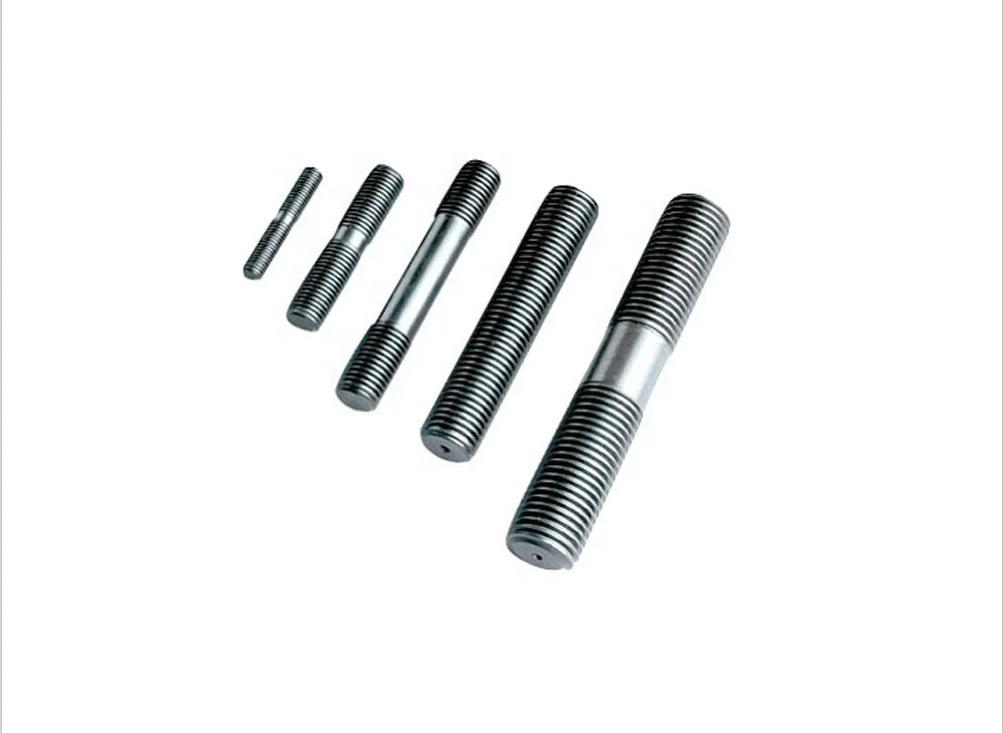
Threaded Rods & Double-End Studs Manufacturer: All-Thread Bar, Custom Studs to Drawing
A threaded rod looks like the simplest fastener there is: a length of round bar with a thread on it. On a drawing it is often the least-specified line item. In practice, the threaded rod on a structural cross-brace, a spring hanger, a pump baseplate or a turbine flange is doing real work — carrying tension, passing through equipment, or connecting two tapped components — and the rod grade, thread form, length and end condition determine whether the joint holds or comes loose.
Yuanpai manufactures custom threaded rods, all-thread bar and double-ended studs for EPC contractors, equipment manufacturers and distributors worldwide, working to ISO and EN material and dimensional standards as primary, with ASTM A193 / A320 grades supplied wherever the customer's drawing calls them up. This guide covers the difference between an off-the-shelf all-thread rod and an engineered stud, the manufacturing choices that control fatigue and corrosion, and the dimensions an RFQ should carry to come back complete the first time.
Yuanpai Threaded Rod & Stud Quick Reference
- Products: fully threaded rod (all-thread bar), double-ended studs, tap-end studs, tie rods, hanger rods
- Primary standards: ISO 898-1 (property classes), ISO 4032/4033 (nut dimensions), ISO 3506 (stainless), EN 10204 (certification)
- Customer-specified grades: ASTM A193 B7/B8M, A320 L7/L7M where the drawing calls them up
- Diameters: M6 to M100 (1/4" to 4")
- Standard lengths: 1 m, 2 m, 3 m all-thread bar; cut to length per drawing
- Threads: rolled (preferred for fatigue) or cut, coarse or fine pitch
- Finishes: plain / phosphate oil, hot-dip galvanized (ISO 10684), zinc flake (ISO 10683), PTFE / Xylan
- Documentation: EN 10204 3.1, per heat; 3.2 with third-party witness on request
1. Threaded Rod, All-Thread Bar and Stud: What Is the Difference?
The three terms are often used loosely on a BOM, but they mean different products:
- All-thread bar (fully threaded rod) — a continuous length of round bar threaded along its full length, sold in standard 1 m, 2 m or 3 m stock lengths and cut to size on site. Used for hanger rods, bracing, conduit supports, equipment ties. It is a general-purpose product, not a precision bolting assembly.
- Threaded rod to length — all-thread material cut to a specific length, with ends chamfered and (where required) a specified thread runout. Used where the engineering drawing fixes the exact rod length.
- Double-ended stud — a precision stud threaded at both ends with a plain or threaded centre section, supplied to a bolting standard. One end engages a tapped hole (the tap end), the other takes a nut. Used on flanges, heat exchangers, valve bodies and equipment where one side is inaccessible.
- Tap-end stud — a stud with a short thread end into a tapped hole and a long thread end for the nut, with the thread engagement calculated for the material.
The distinction matters because the inspection expectations are different. A 3-metre all-thread bar from a hardware supplier is not the same product as a 42CrMo4 10.9 double-ended stud to a flange drawing with a 3.1 certificate. When an RFQ says "threaded rod, 500 pcs", we ask which of these four the project actually needs, because the grade, length tolerance, thread process and documentation all change.
2. Property Classes and Materials
Threaded rods are classified by property class under ISO 898-1 (steel fasteners) and ISO 3506 (stainless). As a custom fastener manufacturer and supplier, Yuanpai works to these ISO / EN systems as primary, and supplies ASTM grades only where the customer's specification explicitly calls them out.
| Class / grade | Standard | Material | Typical tensile | Typical use |
|---|---|---|---|---|
| 4.6 | ISO 898-1 | Low/medium carbon steel | 400 MPa | Light bracing, low-load hangers |
| 5.8 | ISO 898-1 | Medium carbon steel | 500 MPa | General structural threaded rod |
| 8.8 | ISO 898-1 | Quenched and tempered carbon | 800 MPa | Structural bracing, pump baseplates |
| 10.9 | ISO 898-1 | Quenched and tempered alloy (e.g. 42CrMo4) | 1040 MPa | High-load preloaded joints, wind / structural |
| A2-70 | ISO 3506 | 304 stainless | 700 MPa | General corrosion, indoor / atmospheric |
| A4-70 / A4-80 | ISO 3506 | 316 / 316L stainless | 700 / 800 MPa | Coastal, chloride, food and pharma |
| B7 (customer-specified) | ASTM A193 | Cr-Mo alloy | 860 MPa min | High-temperature oil & gas flanges |
| B8M (customer-specified) | ASTM A193 | 316 stainless | 700 MPa min | Corrosive process flanges |
| L7 / L7M (customer-specified) | ASTM A320 | Low-temperature alloy / stainless | 860 / 700 MPa | Sub-zero service, impact-tested |
The procurement rule: state the property class or grade on the RFQ. "Steel threaded rod" without a class could be anything from 4.6 to 10.9, and the load capacity changes by a factor of two. On a structural tension rod, that difference is the difference between a safe connection and an overload failure. The mechanical values in the table are nominal minimums per ISO 898-1; actual tensile and yield stresses for a given class vary with diameter range (for example, the 10.9 minimum yield stress of about 940 MPa applies across the standard diameter groups, with smaller diameters meeting slightly different thresholds), so always confirm the property values against the size range on the drawing.
A note on ASTM grade scope: ASTM A193 and A320 are bolting product specifications, not bar specifications. They cover the finished fastener — material chemistry, heat treatment, mechanical testing, dimensional requirements, marking and certification — end to end. A length of B7 alloy bar cut and threaded on site is not automatically an "A193 B7 stud": to be shipped and certified as A193 B7, the rod must be manufactured, heat-treated, sampled and tested to the full requirements of ASTM A193 (including the applicable finish and inspection clauses), and the certificate must reference the finished-product test results. Where the drawing calls up A193 / A320, the PO should state that the finished stud is to the full product specification, not merely "B7 material".
For more corrosive environments, the material itself changes. Our duplex 2205 fasteners guide covers the 2205 / 1.4462 route for chloride service where 316 is not enough; for high-temperature bolting above about 400 °C, the Inconel 718 high-temperature fasteners guide covers the nickel-alloy route. The same rod and stud manufacturing logic applies in those alloys — the bar is just a higher-specification feedstock.
3. Rolled Threads vs Cut Threads
Thread quality is where a cheap rod and an engineered rod diverge. Two processes:
- Cut threads — a lathe or thread-chasing tool cuts the thread form into the bar. Faster, cheaper, but the grain flow of the steel is interrupted at the thread root, and the surface work-hardening that gives fatigue strength is absent. Acceptable for static, low-load rods (4.6 / 5.8 hanger rods).
- Rolled threads — the thread form is cold-formed between dies, compressing the surface and producing a continuous grain flow around the thread root. Rolled threads have measurably higher fatigue strength and a better surface finish. They are the default on 8.8 and 10.9 rods, on studs for preloaded joints, and on any fatigue-critical application.
For stainless rods, rolling also reduces galling risk under the nut by producing a smoother, more consistent thread root. We roll threads on fatigue-critical and high-strength precision studs (8.8, 10.9 and stainless precision grades), and cut threads only where the customer specifies a static, low-load application and the cost reduction is worth the fatigue trade-off — commercial all-thread bar for light hangers is not rolled on a blanket basis.
Thread pitch is a separate specification point. Coarse pitch (e.g. M24 x 3) is the default for structural rod; fine pitch (M24 x 2) is used where finer adjustment is needed, on thin-wall connections, or where vibration resistance is specified. The nut must match the pitch — a coarse-pitch nut will not run on a fine-pitch rod.
4. Lengths, Ends and Tolerances
A threaded rod order fails in the field most often on length and end condition, not on material:
- Standard all-thread bar is supplied in 1 m, 2 m or 3 m lengths, as drawn. Cut-to-length rods have a saw or cut-off tolerance, typically ±2 mm, which is fine for hanger rods but not for precision flange studs.
- Precision studs are cut and faced to a tighter length tolerance (commonly ±1 mm or per drawing), with both ends chamfered to aid nut engagement.
- Tap-end engagement on a double-ended stud: the short end threads into a tapped hole. The engagement length must be adequate for the material — roughly one diameter in steel, more in softer materials like aluminium or cast iron. Too-short engagement strips out of the tapped hole.
- Thread runout at the end of a precision stud is controlled per drawing; a long runout can prevent a nut from seating fully.
- End chamfer — a 45-degree lead-in chamfer on the rod end lets the nut start square and cross-threading is avoided.
When we quote a custom stud, we confirm the overall length, the thread length at each end, the plain shank length (if any), the chamfer and the runout on the drawing before production. These dimensions are what site crews check first, and they are the most common omission on a first RFQ.
5. Coatings and Corrosion Protection
The finish on a threaded rod is specified together with the material and the service environment:
| Finish | Standard | Typical use | Thread consequence |
|---|---|---|---|
| Plain / phosphate oil | — | Indoor, dry, or where lubricated at assembly | Standard thread fit |
| Hot-dip galvanized | ISO 10684 | External structural bracing, masts, foundations | Threads over-tapped (+0.4 mm typical) to fit over coated rod |
| Zinc flake | ISO 10683 | High-strength 8.8 / 10.9 rods, low hydrogen risk | Thin film; thread fit close to standard; controlled friction |
| PTFE / Xylan dry film | Per coating spec | Galling control on stainless, consistent torque | Thin film; reduces and stabilises K-factor |
| Mechanical galvanizing | ASTM B695 | Where HDG would warp or thin sections | Lower hydrogen risk than HDG on high-strength rod |
For high-strength rods (8.8 and above), electroplated zinc is generally avoided because of hydrogen embrittlement risk — zinc flake or mechanical galvanizing is the safer route. On HDG structural rod, the over-tapped thread and the coating thickness must be documented so the nut (also over-tapped) assembles freely on site.
6. Manufacturing Route at Yuanpai
A precision threaded rod or stud follows a controlled sequence:
- Bar control — hot-rolled or peeled bar from certified mills, with EN 10204 mill certificates verified on receipt. For stainless and alloy grades, chemistry is checked by spectrometer; heat number recorded.
- Cutting and facing — rod cut to length, ends faced and chamfered on a precision saw / CNC line.
- Heat treatment — for 8.8 and 10.9 classes, quench and temper to the required hardness band; for sour-service or low-temperature grades, the hardness and impact controls follow the project specification.
- Thread rolling or cutting — threads rolled after heat treatment on precision rolling machines; gauged with GO / NO-GO thread gauges on each lot.
- Coating — applied in-house or through a qualified coating partner, with thickness and adhesion recorded. For HDG, over-tapping controlled after galvanizing.
- Mechanical testing — tensile, hardness, and (where specified) impact or proof load, per lot.
- Marking and packing — grade and lot traceability on labels; VCI or polybag packing for corrosion protection in transit.
Recent examples include: cut-to-length 8.8 zinc-flake threaded rod for a European solar mounting project; A4-70 rolled-thread studs for a Middle East desalination plant; and custom-length 42CrMo4 10.9 tie rods for a structural bracing package.
7. Documentation for Project Acceptance
Threaded rods on EPC projects are inspected like any other bolting. The pack we prepare:
- EN 10204 3.1 material certificate, per heat, with chemistry and mechanical properties
- Tensile / yield / hardness test report, per lot
- Thread gauging record (GO / NO-GO)
- Dimensional report: length, thread length at each end, runout, chamfer
- Coating report where coated (thickness, adhesion, salt-spray hours per spec)
- Heat and lot traceability from bar mill cert to box label
For ASTM-grade rods (B7, B8M, L7) supplied on customer-specified projects, the certificate references the ASTM grade as called up on the drawing, and any third-party witness (SGS, BV, TÜV) is arranged at quotation.
For North American projects, the additional reference standards buyers commonly call up are: ASME B18.31.3 for dimensions and tolerances for externally threaded steel rod; ASTM F606 / F606M for the standardized test methods used to determine tensile, yield and hardness properties of externally and internally threaded fasteners; and ASTM F2329 for zinc hot-dip galvanizing requirements applied to bolts, screws, studs and nuts. Where the drawing references these, we test and certificate to them alongside the ISO / EN product spec.
8. Supplier Evaluation Card
Use this card when comparing threaded rod and stud suppliers. The points below reflect what EPC procurement and project engineers typically ask us to demonstrate.
| Evaluation point | What to ask the supplier | Why it matters |
|---|---|---|
| Thread process | Are fatigue-critical threads rolled after heat treatment? | Cut threads directionally reduce fatigue performance on preloaded / fatigue joints |
| Grade control | Can they state property class or ASTM grade on every lot? | Unspecified "steel rod" is a procurement risk |
| Length tolerance | What tolerance on cut-to-length and stud length? | Precision studs need ±1 mm, not ±5 mm |
| Tap-end engagement | Do they calculate / confirm tap-end thread engagement? | Under-engaged studs strip out of tapped holes |
| Coating control | Is HDG over-tap and zinc-flake bake-out controlled? | Poor over-tap = nuts will not assemble on site |
| Traceability | Does the heat number run from mill cert to box label? | EPC inspectors trace every rod |
| ASTM flexibility | Can they supply A193 / A320 when the drawing calls them up? | Many projects mix ISO and ASTM line items |
| Stainless experience | Do they roll stainless threads to reduce galling? | Stainless rod on unrolled threads seizes under torque |
| Certificate format | 3.1 in English, per heat, matching PO line items? | Owner inspectors reject handwritten or non-conforming certs |
9. RFQ Dimensions: What to Send for a Complete Quotation
Threaded rod RFQs come back with clarifying questions most often when the product type or end condition is missing. Send the following on the first request:
| RFQ field | Example | Notes |
|---|---|---|
| Product type | All-thread bar, cut-to-length rod, or double-ended stud | Different production routes |
| Thread size and pitch | M24 x 3 coarse, or M24 x 2 fine | Pitch must match the nut |
| Property class / grade | 8.8, A4-70, or ASTM A193 B7 (customer-specified) | State it explicitly |
| Length | 2,000 mm stock bar, or 350 mm precision stud | Tolerance needed for studs |
| Thread configuration | Full thread, or equal-end double-ended, or tap-end | Tap-end needs engagement length |
| End condition | Chamfered both ends, per drawing | Cross-threading prevention |
| Quantity | e.g. 5,000 m of all-thread, or 800 pcs studs | Meters vs pieces changes pricing |
| Coating | Plain, HDG ISO 10684, zinc flake ISO 10683, PTFE | HDG needs over-tap confirmation |
| Certification | EN 10204 3.1; 3.2 with SGS witness if required | Agreed at quotation |
| Packaging | VCI bags, count / length per bundle | Site inventory control |
Reply with these fields and we return a complete quotation — material, thread process, coating and documentation — without a follow-up round trip.
10. Common Field Mistakes
- Buying "threaded rod" without a property class. A 4.6 rod and a 10.9 rod look the same; the load capacity is two to three times different.
- Mixing coarse and fine pitch. A fine-pitch nut will not start on a coarse rod, and vice versa. State the pitch.
- HDG rod without over-tapped nuts. The zinc layer binds the thread and the nut will not run on.
- Cut threads on a fatigue-critical stud. Cheaper, but the interrupted grain flow at the thread root reduces fatigue performance. Specify rolled threads for preloaded or cyclically loaded studs.
- Tap-end studs with too-short engagement. The short end strips out of the tapped hole under load. Confirm engagement against the host material.
- Reusing bent or damaged rod. Straightening a threaded rod work-hardens and weakens it; replace it.
For corrosive rod applications beyond 316, see our duplex 2205 fasteners guide; for high-temperature service above 400 °C, see the Inconel 718 guide. For the broader custom fastener range, start at the custom fastener manufacturer center.
FAQ
Q: What is the difference between a threaded rod and a stud bolt?
A: A threaded rod (all-thread bar) is continuous-thread general-purpose stock, cut to length on site. A stud bolt is a precision fastener made to a bolting standard with defined thread lengths at each end, a controlled runout and matched nuts, supplied with certificates. The inspection and traceability expectations are different.
Q: What property class should I specify for structural bracing rod?
A: 8.8 (quenched and tempered carbon steel) is the common choice for loaded structural tension rod. 5.8 is adequate for light hangers; 10.9 is used where the joint is preloaded or high-load. Follow the structural engineer's specification.
Q: Can you supply ASTM A193 B7 threaded rod?
A: Yes. We work primarily to ISO / EN standards, but supply ASTM A193 B7, B8M and A320 L7 / L7M rods and studs wherever the customer's drawing calls them up, with certificates referencing the ASTM grade.
Q: Are your threads rolled or cut?
A: Fatigue-critical and high-strength studs (8.8, 10.9, stainless precision studs) are thread-rolled after heat treatment. Cut threads are used only where the customer specifies a static, low-load application and the cost trade-off is accepted.
Q: Do you supply the matching nuts?
A: Yes. Rods and studs are supplied with matching nuts (heavy hex or standard hex, in the same grade) and washers where required, with the grade match documented on the packing list.
Q: What certificates are included?
A: EN 10204 3.1 per heat, with chemistry, mechanical properties, thread gauging and dimensional records. 3.2 certificates with third-party witness are arranged where the project requires.
Request a Quotation
Send the RFQ dimensions above — or attach the drawing for custom studs — and we will confirm material, thread process, length tolerance, coating and the documentation pack within one working day. For projects mixing ISO and ASTM line items, send the BOM and we will map each line to the correct grade and standard.
Email: sales@ypfasteners.com
We manufacture custom threaded rods, all-thread bar and double-ended studs for EPC contractors, equipment OEMs and distributors, with the test and certificate scope agreed at quotation so the delivered pack matches the commercial order.
Related guides: Custom Fastener Manufacturer Center, Duplex 2205 Fasteners, Inconel 718 High-Temperature Fasteners